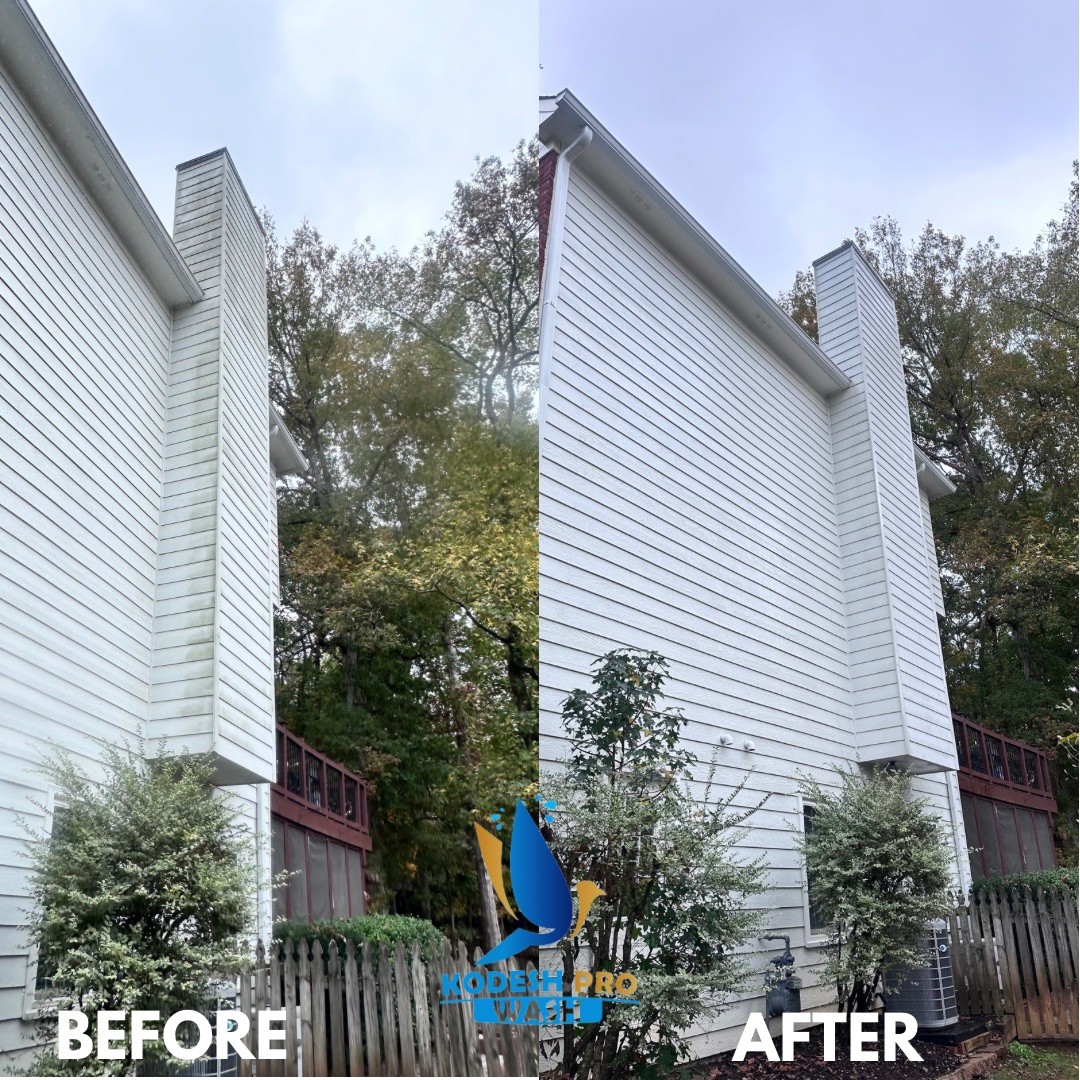
Short answer: the north side of a house turns green first because it gets the least direct sun, so it stays damp longest after rain and dew. Mildew and algae need moisture, and that wall gives it to them. Trees, shrubs close to the wall and sprinklers make it worse. A low-pressure soft wash removes the growth; trimming, airflow and keeping water off the wall help slow its return.
If you live in Johns Creek and one wall of your house looks noticeably greener than the rest, you're in good company. Here's why it happens, how to tell what you're looking at, and what actually works.
Why the north side?
In Georgia, the sun tracks across the southern part of the sky, so north-facing walls spend most of the day in shade. After a rain, a heavy dew or an evening sprinkler cycle, the south and west walls dry quickly in the sun. The north wall can stay damp for hours longer. Add Georgia humidity and you have ideal conditions for mildew and green algae.
Other things that keep a wall wet:
- Trees and tall shrubs that block sun and air movement.
- Sprinkler heads that hit the siding instead of the lawn.
- Clogged or overflowing gutters that spill water down the wall.
- Mulch or soil piled against the bottom of the siding, which holds moisture and splashes dirt up.
Is it dirt or mildew?
Green, gray-green or black patches that are heavier in shaded areas are almost always organic growth rather than plain dirt. A simple homeowner check: wearing gloves, dab a little diluted household bleach on an out-of-the-way spot. If the stain lightens within a few minutes, it's mildew or algae. If nothing changes, it's more likely dirt, clay or another kind of stain. Rinse the spot with water afterward.
Why a quick pressure wash doesn't last
Blasting a green wall with high pressure removes what you can see, but it often leaves the growth's roots behind in the texture of the siding, so the green comes back quickly. High pressure can also scar vinyl, strip paint, chip mortar on brick and stone, and drive water behind siding panels where it can't dry out. That's the opposite of what a damp wall needs.
How soft washing handles it
Soft washing uses a cleaning solution — industry-standard sodium hypochlorite with biodegradable surfactants — applied at low pressure. The solution kills the growth instead of just knocking it off, and a gentle rinse carries it away. Plants nearby are pre-rinsed and protected before the solution goes on and rinsed again afterward. It works on vinyl, painted fiber cement, brick and stone, which matters in Johns Creek where many homes mix siding with a brick or stone front.
Read more about our house washing.
Slowing it down after cleaning
You can't change which way your house faces, but you can make that wall dry faster:
- Trim branches that hang over the roof or touch the wall, and thin shrubs so air can move behind them.
- Adjust sprinkler heads so they water the beds, not the siding.
- Keep gutters and downspouts clear so rain goes where it should.
- Pull mulch back a few inches from the bottom of the siding.
- Rinse the wall with a garden hose a few times a year to knock off pollen and dirt before growth takes hold.
How often to wash
For most Georgia homes, a full house wash every 12–18 months keeps things looking right. A heavily shaded north wall may need attention sooner. Washing the whole house on a schedule — rather than waiting until one side is obviously green — keeps all four sides looking even.
What about the roof?
The same shade that greens a wall often shows up as black streaks on the north slope of the roof. That's a type of algae too, and it should be soft washed, not pressure washed. Roof cleaning is $0.30 per sq ft with a $450 minimum; see how it works.
Pricing
House washing is $0.18 per sq ft with a $200 minimum, and driveway and walkway cleaning is $0.15 per sq ft with a $200 minimum. You can see a range in about two minutes with our instant price tool. Every house wash comes with our 6-Month Spot-Free Warranty.
Get help in Johns Creek
Kodesh Pro-Wash is family-owned and owner-operated, locally owned and serving Gwinnett & North Fulton. See our Johns Creek pressure washing page for services, reviews and common questions, or call or text (678) 916-8616 — we answer 7 AM – 10 PM, 7 days a week.
Separate cleaning from moisture repairs
If the same patch stays wet after surrounding siding dries, look for a source of water before simply booking repeated cleaning. A leaking gutter joint, sprinkler aimed at the wall or damaged trim can keep supplying moisture. Washing removes suitable surface buildup but cannot repair those conditions. Photograph the area in dry weather and after rain, then discuss repairs with the relevant professional if needed. Avoid sealing over damp or deteriorated materials. For a Johns Creek house wash, share these observations when requesting the scope so existing issues are noted before cleaning starts.
See the matching cleaning service and local service-area details, or request your property quote. Call or text (678) 916-8616. Serving Suwanee and Gwinnett/North Fulton.
Get Your Free Quote in Minutes
Skip the research — tell us about your property and we'll send a free, no-pressure estimate. Most quotes back same day.
- Licensed, insured, 5-star Google reviews
- Free, no-pressure estimates with upfront pricing
- 6-month spot-free warranty on house washes
Get Your Free Quote
Takes 30 seconds · We respond in as little as 10 minutes